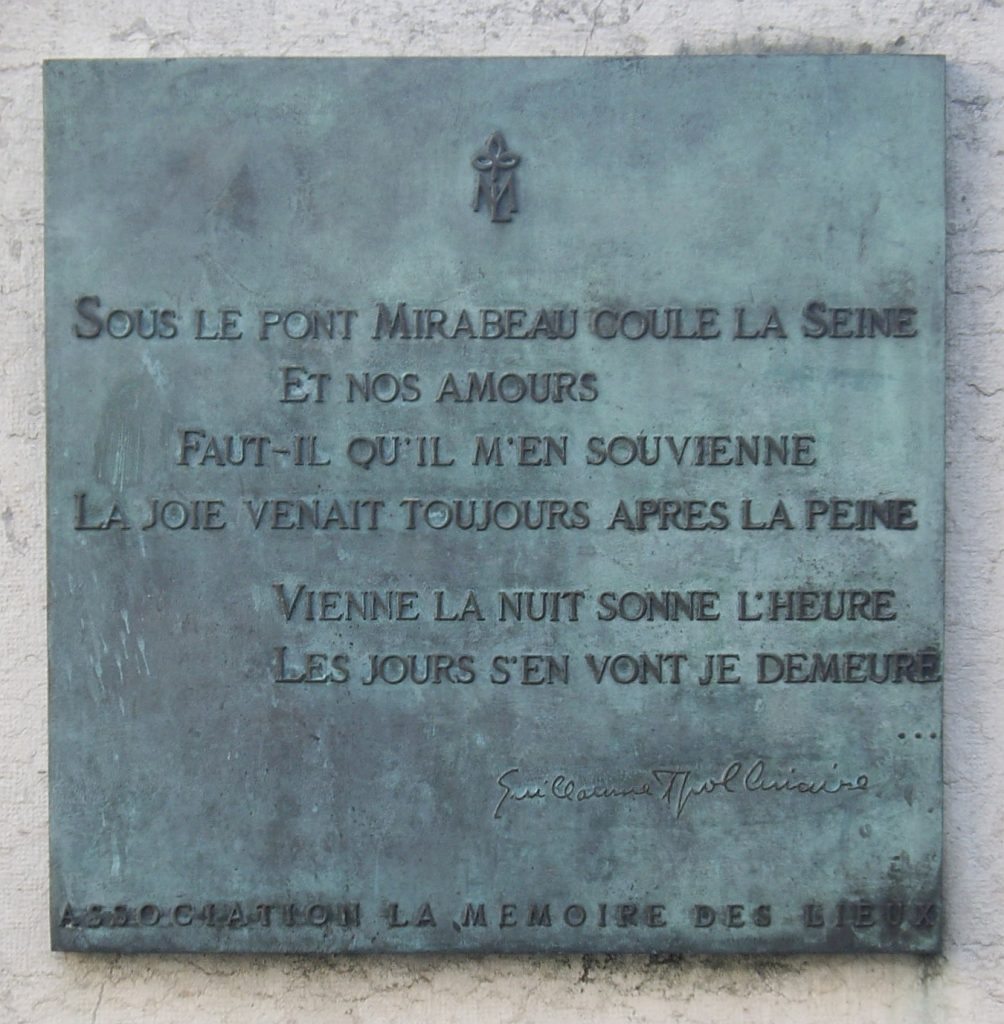
Le Pont Mirabeau talks about lost love by likening it to the flow of the river Seine under the Mirabeau bridge in Paris. This poem was first released in 1912 and re-released in 1913 in Guillaume Apollinaire’s collection called Alcools.
Today, you can see a plaque containing the first part of the poem on a wall in Le Pont Mirabeau in Paris, overlooking the Louis Bleriot quay.
It took 1,000 years for the invention of paper to spread from China to Europe. Nowadays, in a world that has become more integrated, innovations spread faster and through many channels.
Our research in Chapter 4 of the April 2018 World Economic Outlook takes a closer look at how technology travels between countries. We find that the spread of knowledge and technology across borders has intensifiedbecause of globalization. In emerging markets, the transfer of technology has helped to boost innovation and productivity even in the recent period of weak global productivity growth.
Why spreading technology matters
Technological progress is a key driver of improvements in incomes and standards of living. But new knowledge and technologies do not necessarily develop everywhere and at the same time. Therefore, the way technology spreads across countries is central to how global growth is generated and shared across countries.
Indeed, during 1995–2014, the United States, Japan, Germany, France, and the United Kingdom (the G5) produced three-fourths of all patented innovations globally. Other large countries—notably China and Korea—have started to make significant contributions to the global stock of knowledge in recent years, joining the top five leaders in a number of sectors. While this suggests that in the future they too will be important sources of new technology, during the period under study, the G5 constituted the bulk of the technology frontier.
To trace knowledge flows, our study uses the extent to which countries cite patented innovations from the technology leaders as prior knowledge in their own patent applications. The chart below gives a representation of these cross-country knowledge links. Two features stand out. First, while in 1995 the United States, Europe, and Japan were dominating global patent citations, China and Korea (depicted together as “other Asia”) have made increasingly large use of the global knowledge stock as measured by their patent citations. Second, knowledge links have in general intensified over time, both within (red arrows) and across (blue arrows) regions. An alternative measure for the extent to which foreign knowledge is available for domestic use is the intensity of international trade with technology leaders—and our study looks at this as well.
Globalization boosts technological development
The increasing intensity of global knowledge flows points to important benefits of globalization. While globalization has been much criticized for its possible negative side effects, our study shows that globalization has amplified the spread of technology across borders in two ways. First, globalization allows countries to gain easier access to foreign knowledge. Second, it enhances international competition—including as a result of the rise of emerging market firms—and this strengthens firms’ incentives to innovate and adopt foreign technologies.
The positive impact has been especially large for emerging market economies, which have made increasing use of the available foreign knowledge and technology to boost their innovation capacity and labor productivity growth. For instance, over 2004–14, knowledge flows from the technology leaders may have generated, for an average country-sector, about 0.7 percentage point of labor productivity growth per year. This amounts to about 40 percent of the observed average productivity growth over 2004–14. We find that one important factor behind the build-up of innovation capacity in emerging market economies has been their growing participation in global supply chains with multinational companies, though not all firms have benefitted as multinationals sometimes reallocate some innovation activity to other parts of the global value chain.
The increased transfer of knowledge and technology to emerging market economies has partly offset the effects of the recent slowdown in innovation at the technology frontier and helped drive income convergence for many emerging economies. In contrast, advanced economies have been more affected by the technology slowdown at the frontier.
Finally, our study finds evidence that technology leaders themselves benefit from each other’s innovation. This suggests that, going forward, with the growing contribution of China and Korea to the expansion of the technology frontier, there may be scope for positive spillovers from these new innovators to the traditional innovators. Knowledge and technology do not flow in one direction only.
Spreading the know-how
Globalization brings a key benefit—it stimulates the spread of knowledge and technology, helping spread growth potential across countries. But interconnectedness per se is not enough. The assimilation of foreign knowledge and the capacity to build on it most often requires scientific and engineering know-how. Investments in education, human capital, and domestic research and development are thus essential to build the capacity to absorb and efficiently use foreign knowledge. It also requires an appropriate degree of protection and respect of intellectual property rights—both domestically and internationally—to preserve the ability of innovators to recover costs while ensuring that the new knowledge supports growth globally.
Policymakers must also make certain that the positive growth benefits from globalization and technological innovation are shared widely across the population, including by ensuring that innovating firms do not exploit the newly acquired technology to gain excessive control of a market to the detriment of consumers.
When you’re up against a trouble, Meet it squarely, face to face; Lift your chin and set your shoulders, Plant your feet and take a brace. When it’s vain to try to dodge it, Do the best that you can do; You may fail, but you may conquer, See it through!
Black may be the clouds about you And your future may seem grim, But don’t let your nerve desert you; Keep yourself in fighting trim. If the worst is bound to happen, Spite of all that you can do, Running from it will not save you, See it through!
Even hope may seem but futile, When with troubles you’re beset, But remember you are facing Just what other men have met. You may fail, but fall still fighting; Don’t give up, whate’er you do; Eyes front, head high to the finish. See it through!
Compound verbs contain at least two words: a conjugated auxiliary and a past participle. In this unit, we will cover the passé composé (PC), which can translate to the English past simple or present perfect.
The French PC is the tense of choice to translate the English past simple. The French language also has a past simple tense, but it has run out of use, except in formal writing and in third person singular and plural.
Elle a vu ce chien. — She has seen/saw that dog.
Ils ont dit la vérité. — They (have) told the truth.
In both languages, the compound verb begins with an auxiliary verb (avoir and “to have” here) that is conjugated according to the subject. A past participle (e.g. vu or “seen”) follows the auxiliary and remains invariable.
With the auxiliary avoir, the past participle never agrees with the subject.
Auxiliaries
In English, the active present perfect has only one auxiliary verb (“to have”), but the PC has two: avoir and être. Most verbs use avoir.
J’ai été malade. — I have been sick.
Il a appelé un docteur. — He has called a doctor.
A handful of verbs use être. The mnemonic “ADVENT” may help you remember these.
Initial Verb
Opposite Verb
Related Verbs
Arriver (arrive)
partir (leave)
Descendre (descend)
monter (ascend)
Venir (come)
aller (go)
devenir (become), revenir (return)
Entrer (enter)
sortir (leave)
rentrer (re-enter)
Naître (be born)
mourir (die)
Tomber (fall)
The remaining verbs are passer (pass), rester (stay), retourner (return), and accourir (run up). Notice that être verbs often involve movement or transformation.
Il est venu. — He has come.
Septembre est passé. — September has passed.
Je suis devenu roi. — I have become king.
Also, all pronominal verbs use être.
Elle s’est souvenue de ses amis. — She has remembered her friends.
Ils se sont rasés. — They have shaved.
With the auxiliary être, the past participle agrees with the subject.
Object pronouns, negations, and inversions appear around the auxiliary.
Je l‘ai entendu(e). — I have heard him (her).
Il ne m‘a pas trouvé(e). — He has not found me.
Avez-vous vu les robes ? — Have you seen the dresses?
Pourquoi l’avez– vous fait ? — Why have you done it?
Past Participles
A participle is a special non-conjugated form of a verb. Most participles are formed by adding an ending to a verb’s root.
Group
Ending
Example
-er verbs
-é
manger ⇒ mangé
-ir verbs
-i
choisir ⇒ choisi
-re verbs
-u
vendre ⇒ vendu
Unfortunately, most irregular verbs have irregular participles. For instance, the past participle of venir is venu.
Il est venu. — He has come.
Les filles sont venues. — The girls have come.
Note that participles vary with gender and number just like adjectives when the auxiliary is être.
Gender
Singular
Plural
Masculine
venu
venus
Feminine
venue
venues
Adverbs appear right before the participle.
Je l’ai souvent entendu. — I often heard him/her/it.
Je vous en ai déjà parlé. — I already talked to you about it.
PARTICIPLE AGREEMENT
A participle that follows avoir is usually invariable.
L’homme a mangé. — The man has eaten.
Les femmes ont mangé. — The women have eaten.
However, if a direct object appears before avoir, its participle agrees with the direct object. Below, vues agrees with the plural feminine robesbecause les precedes the verb.
Tu as vu les robes ? — Have you seen the dresses?
Oui, je les ai vues. — Yes, I have seen them.
A participle that follows être agrees with the subject.
L’homme est venu. — The man has come.
Les hommes sont venus. — The men have come.
La femme est venue. — The woman has come.
Les femmes sont venues. — The women have come.
However, if a pronominal verb is intransitive, then the participle is invariable. For instance, compare s’appeler (transitive: appeler quelqu’un) to se téléphoner (intransitive: téléphoner à quelqu’un).
Nous nous sommes appelés. — We called each other. (For a masculine nous.)
Nous nous sommes téléphoné. — We called each other. (For both genders of nous.)
Using the PC
Translating the past tense can be difficult because the English simple past (preterit) overlaps the French passé composé and imparfait (taught later in the “Past Imperfect” unit). The PC can translate to the preterit when it narrates events or states that began and ended in the past. In this usage, the PC often appears with expressions of time or frequency like il y a, which means “ago” when followed by a duration.
La fille a mangé il y a cinq minutes. — The girl ate five minutes ago. (A single specific event.)
Les enfants ont eu froid hier. — The children were cold yesterday. (A state on a specific date.)
Je suis tombé(e) plusieurs fois. — I fell several times. (Multiple specific actions.)
Je suis déjà tombé(e). — I already fell. (An event in an undetermined time frame.)
The PC can also translate to the present perfect for actions and states that started in the past and are still true.
Il n’a jamais mangé de pâtes. — He has never eaten pasta.
In English, many adverbs are constructed from adjectives by adding “-ly” to the end. For instance, “quick” becomes “quickly”. In French, add -mentto feminine adjectives to create adverbs.
facile (easy) ⇒ facilement (easily)
forte (strong) ⇒ fortement (strongly)
grande (great) ⇒ grandement (greatly)
However, if the masculine form ends in -nt, replace that ending with -mment instead.
constant (constant) ⇒ constamment (constantly)
prudent (prudent) ⇒ prudemment (prudently)
Adverbs with Negations
In negative clauses, adverbs that would otherwise follow the verb usually appear after the negation.
Nous ne vivons pas ensemble. — We don’t live together.
In “U17: Conjunctions 1”, you learned about coordinating conjunctions, which link similar elements that have equal importance in a sentence. However, in complex sentences, one clause may be dependent on another.
The subordinating conjunctions are as follows:
Sub. Conjunction
English Meaning
comme
as, since
lorsque
when
puisque
as, since
quand
when, whenever
que
that
quoique
even though
si
if
Il mange quand il a faim. — He eats whenever he is hungry.
In this example, quand il a faim (“whenever he is hungry”) is a dependent clause because it gives more information about the main clauseil mange(“he eats”). The dependent clause is introduced by quand, which is a subordinating conjunction.
Tu dois rester au lit puisque tu es malade. — You must stay in bed since you are sick.
J’espère que vous allez mieux. — I hope (that) you are feeling better.
Unlike coordinating conjunctions, subordinating conjunctions can begin sentences.
Comme je suis en retard, je vais rater mon train. — Since I am late, I’m going to miss my train.
Lorsque le garçon mange, la fille mange. — When the boy eats, the girl eats.
Two or more words can join together to form a conjunctive phrase which acts as a conjunction. Many conjunctive phrases end in que, such as “parce que”, “alors que”, “pendant que”, “après que”, etc.
Pendant que je lis, il écrit. — While I read, he writes.
TEMPORAL CONJUNCTIONS
Quand and lorsque both mean “when”, but they aren’t always interchangeable. Both can be used for temporal correlations, but lorsquecannot be used in direct or indirect questions. Only quand is also an adverb, so it can be used in questions. When in doubt, use quand.
Je sortais quand/lorsque tu es arrivé(e). — I was leaving when you arrived.
Je mange quand/lorsque j’ai faim. — I eat when (whenever) I am hungry.
Quand mangez-vous ? — When do you eat?
Je veux savoir quand le train part — I want to know when the train leaves.
Alors que, pendant que, and tandis que can indicate simultaneity.
Je mange alors que tu manges. — I eat while you eat.
Pendant que tu bois, je bois. — While you drink, I drink.
Je fais la salade tandis que vous mettez la table. — I make the salad while you set the table.
Alors que and tandis que can also indicate a contrast, contradiction or opposition, though this is rare for tandis que.
Elle est grande, alors que je suis petit. — She is tall, whereas I am short.
Je mange alors que je n’ai pas faim. — I am eating even though I am not hungry.
On est en été ici tandis que c’est l’hiver là-bas. – It’s summer here whereas it’s winter over there.
CAUSAL CONJUNCTIONS
Parce que, car, and puisque all mean “because” and describe some kind of cause-and-effect relationship, but they aren’t completely interchangeable.
Parce que is a subordinating conjunction that provides an explanation, motive, or justification.
Elle lit parce qu’elle a un livre. — She is reading because she has a book.
Parce qu’elle est jeune, elle est jolie. — She is pretty because she is young.
Car is similar to parce que, but it’s a coordinating conjunction and thus cannot begin a sentence or clause.
Je mange du poulet car j’aime la viande. — I am eating chicken because I like meat.
Puisque is a subordinating conjunction that means “because” or “since” and gives an already-known or obvious reason or justification.
Puisqu’il pleut, j’ai un parapluie. — Since it’s raining, I have an umbrella.
ELISIONS WITH SI AND QUE
Usually, only one-syllable words ending in -e can be elided (je, de, le, ne, me, te, se, que) as well as puisque, quoique, and jusque.
However, si can elide but only before il and ils, so you must write s’il/s’ils, but si elle/si elles.
A negation changes the meaning of a statement to its negative. Most French negations are constructed out of two words that surround a conjugated verb.
Je ne comprends pas. — I don’t understand.
Il ne parle pas anglais. — He doesn’t speak English.
Note that the particle ne elides before vowel sounds.
Vous n’avez pas de chien. — You don’t have a dog.
Ils n’aiment pas le menu. — They don’t like the menu.
Along with ne…pas, there are a number of other negations you can use.
Ne… plus: not anymore/no more/not any longer/no longer
Elle n’a plus de lait. — She no longer has milk.
Il ne peut plus marcher. — He can’t walk any longer.
Ne… jamais: not ever/never
Je ne sais jamais. — I never know.
Je ne gagne jamais. — I don’t ever win.
Ne… rien: not anything/nothing
Je n’ai rien. — I have nothing.
Elles ne voient rien. — They don’t see anything.
Ne… personne: not anybody/nobody/not anyone/no one
Je ne vois personne. — I don’t see anybody.
Il n’aime personne. — He doesn’t like anyone.
Ne… aucun: none/no [thing]/not one/not any (note that “aucun” must agree in gender with the thing being negated, but it is always singular.)
Elle n’aime aucun homme politique. — She likes no politician./She doesn’t like any politician.
Je n’ai aucune idée. — I have no idea./I don’t have any idea.
Note that in negations, indefinite and partitive articles change to de.
Elle n’a pas de lait. — She doesn’t have milk. (Not du lait.)
Je n’entends plus de bruit. — I don’t hear a sound anymore. (Not un bruit.)
Je n’entends jamais d’oiseaux. — I never hear any birds. (Not des oiseaux.)
Of course, there’s an exception: when negating être, all articles may be used.
Ce liquide n’est pas du lait. — This liquid isn’t milk.
Ce n’est pas un couteau. — That’s not a knife.
Ce ne sont pas des soldats. — They are not soldiers.
Negative Pronouns and Conjunctions
In addition to the negative adverbs above, you also have the option of starting a sentence with a negative adverb, which acts like a masculine subject. Both personne and rien can also be negative pronouns if you put ne after them.
Personne ne means “nobody”.
Personne ne sait. — Nobody knows.
Personne n’aime cela. — Nobody likes that.
Rien ne (“nothing”) is the pronoun version of ne…rien.
Rien n’est parfait. — Nothing is perfect.
Rien n’est si dangereux qu’un ignorant ami. (Jean de La Fontaine) — Nothing is so dangerous as an ignorant friend.
The negative conjunction ni can be used to add something to a negation and is similar to the English “nor”. Think of it as a negative form of et(“and”). Ni can be used in addition to other negative adverbs.
Elle ne connaît ni toi ni moi. — She knows neither you nor me. (Or “She doesn’t know you or me.”)
Je ne veux ni ce repas ni cette boisson. — I want neither this meal nor this drink.
Il ne fait jamais chaud ni froid. — It is never hot or cold.
When ni coordinates multiple conjugated verbs, each verb must be preceded by ne.
Je ne lis pas, ni n’écris. — I don’t read or write.
Il ne veut ni ne peut manger de colle. — He neither wants nor is able to eat glue.
Word Order
When the negated verb has a pronoun object, it belongs right after ne.
Je ne les aime pas. — I don’t like them.
Je n’en ai pas. — I don’t have any. (Lit: “I do not have any of it.)
When a negation is used with an inversion (to ask a question), the whole inversion must remain inside the negation.
Ne comprenez-vous pas ? — Don’t you understand?
Pourquoi ne l’as-tu pas ? — Why don’t you have it?
Unconjugated verbs like infinitives must come after the negation.
Ne pas toucher. — Do not touch.
Elle choisit de ne pas manger. — She chooses not to eat.
Extra adverbs that modify the verb usually come after the negation. Otherwise, they follow the rules from “Adverbs 1”.
On ne marche pas vite. — We aren’t walking quickly.
Elle ne vient jamais ici. — She never comes here.
Other Notes
In English, two negatives may make a positive, but in French, they usually don’t. For instance, consider ne… jamais rien, which is “never… anything”, not “never… nothing”.
Ils ne vont jamais rien perdre. — They will never lose anything.
Elle ne mange jamais rien. — She never eats anything.
Il n’y a rien de plus important que la liberté. — There is nothing more important than liberty.
The particle ne is often skipped or slurred in casual speech. It’s also omitted for short phrases that lack a verb.
Pas si vite ! — Not so fast!
Pas de problème. — No problem.
Remember that verbs of appreciation (e.g. aimer) require the definite article in French. Negations are no different.
I don’t like fish. — Je n’aime pas le poisson. (Not Je n’aime pas de poisson.*)
Remember that occupations can act as adjectives when used with être or devenir, so unlike in English, the French often drop the indefinite article (un, une, des) before an occupation.
Je suis juge. — I am a judge.
Elle va devenir avocate. — She is going to become a lawyer.
Ses parents sont boulangers. — His/Her parents are bakers.
However, if any specification follows the occupation, then the indefinite article must be added.
Tu es un juge respecté par tous. — You are a judge respected by all.
Il veut devenir un professeur pour adultes. — He wants to become a teacher for adults.
Omitting the indefinite article is optional. However, if it’s included in the third-person, then you must use c’est or ce sont.
C’est un juge. — He’s a judge.
C’est une dentiste bien connue. — She is a well-known dentist.
Ce sont des journalistes. — They are journalists.
Genders in Occupations
Some occupations have the same form in both masculine and feminine.
un médecin — a doctor
un/une juge — a judge
un/une journaliste — a journalist
un/une pédiatre — a pediatrician
un/une dentiste — a dentist
un/une secrétaire — a secretary
un/une ingénieur — an engineer
un professeur — a teacher
Some professions do not reflect the gender of the person at all and are invariable; un médecin, un professeur, and un maire, for instance, are all masculine regardless of the person doing the work.
Other occupations have a feminine form that’s derived from the masculine: